idea-ly
Your team already has the next great idea.
- apps for employees and administrators
- 2
- idea submission available
- Anonymous
- status and assessment of each idea
- Visible
BACKGROUND
In 2019, I was commissioned to develop a Website for idea-ly. After we worked together, I soon wanted to get involved with the actual software as well—and take technical development into my own hands. Until then, development had been outsourced overseas. The design and technology weren’t ideal and didn’t follow industry standards.
By that point, the company already had customers actively using the tool. And there was a backlog of requests for changes.
WHAT CAN IDEA-LY DO?
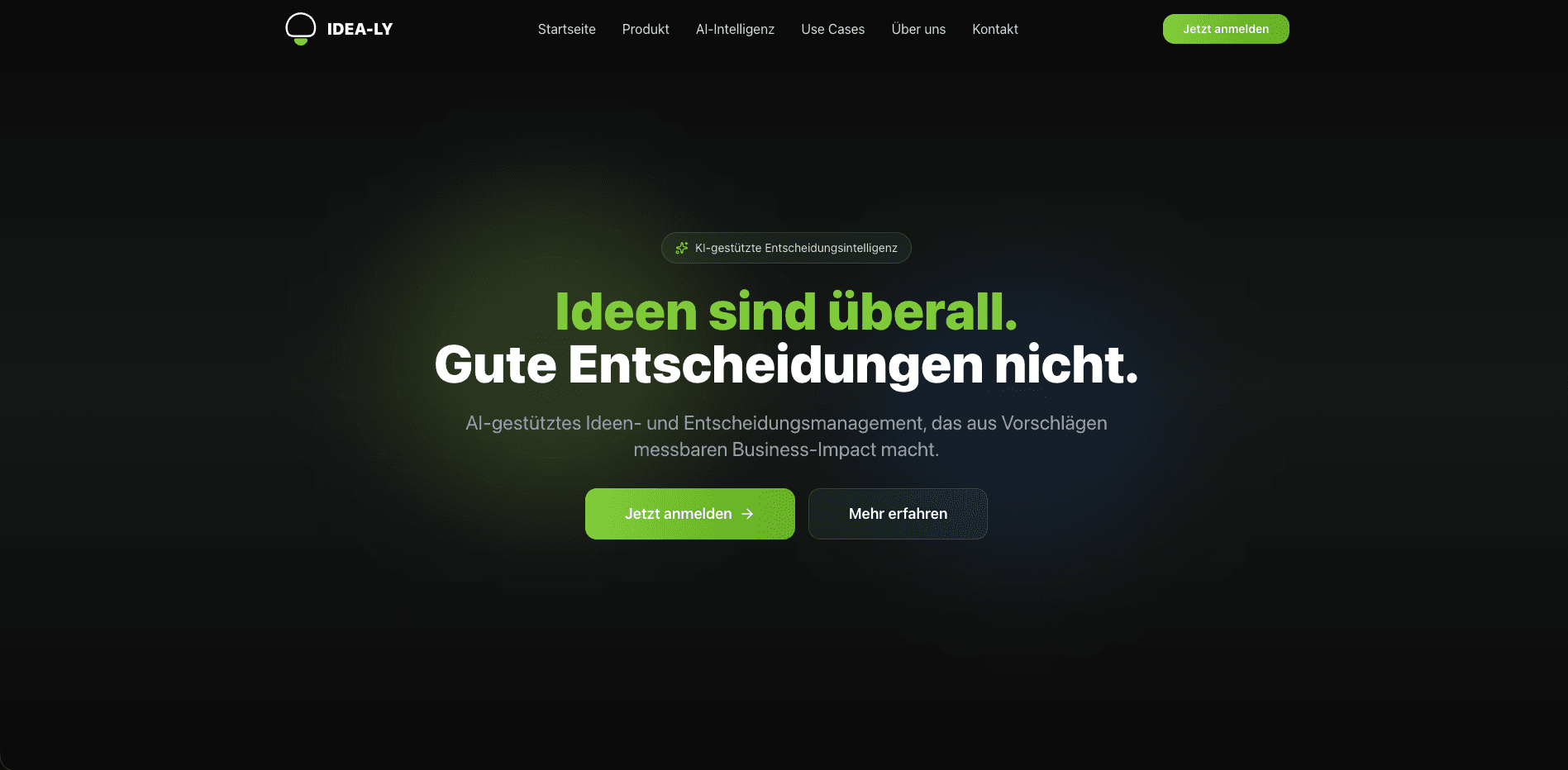
idea-ly is an idea management tool for companies that want to keep up with the times. Many companies lose good ideas and opportunities for improvement because their most valuable resource—their employees—isn’t heard. idea-ly addresses exactly that problem.
At its core, the platform consists of two tools: the client tool for employees and the admin dashboard.
The client tool is deliberately kept simple. Employees can submit their ideas through an interactive interface—quickly and easily. They can use an email address or remain completely anonymous. As soon as an idea is submitted, the admins are notified.
The dashboard is the control center. Here, admins can see all submitted ideas, assign and categorize them, and set a status to show what stage an idea is at. They can also give ideas a positive or negative rating.
TECHNICAL IMPLEMENTATION
The goal was clear: bring the web app up to date and make it more modern for customers. The old codebase was built on Flutter, which was replaced entirely with Nuxt.js, creating an environment that simplifies development and is closer to web standards.
Supabase was used for the backend and database—including authentication. Hosting is handled by Vercel. Lean, serverless, and without unnecessary overhead.
One important architectural decision was to build the client tool and admin dashboard as two separate tools. The aim was to avoid ending up with a monolithic structure. Keeping them separate means both sides are independently maintainable and scalable.
CHALLENGES & LESSONS LEARNED
Customers waiting, migration underway. The start at idea-ly was a little bumpy. Customers were already waiting for improvements and wanted the software delivered as soon as possible. But it couldn’t happen that quickly, because we were in the middle of a technical migration and wanted to realign the strategy. This meant many rounds of discussions with customers to meet their requirements without losing sight of the long-term direction.
Separation, not a monolith. Building the client tool and admin dashboard separately and cleanly was a challenge. But that decision paid off: two independent tools, each optimized for its purpose, rather than an overblown monolith where every change affects everything else.
From developer to managing director. What began as an external development contract gradually became much more. I bought shares in idea-ly, later acquired more—and today I’m the managing director. The project didn’t just evolve technically; my role in it evolved too.
WHAT’S NEXT?
idea-ly wants to keep pace with the times and offer customers the latest technologies and possibilities. That’s why we’re planning to use AI to organize and structure ideas in the future. This can help companies use AI as a sparring partner and identify where there is room for improvement.
This way, many ideas can be grouped automatically, and the company can check its current status with a single query. Not as a replacement for employees, but as a tool that makes their ideas even more valuable.
LOOKING BACK
idea-ly shows how projects can evolve when you stick with them. A website contract became a technical takeover, which became a product, which led to an equity stake. The technology was turned on its head, customers had to be brought along, and the architecture was built to grow rather than stagnate.
The most important lesson: great products don’t emerge in a vacuum. They emerge when real users have real problems—and you’re close enough to listen.