Futouris
Knowledge makes a difference when people can access it.
- content and page editing
- Independent
- toolkits for sustainable tourism
- Structured
- changes before publishing
- Preview
ABOUT FUTOURIS
Futouris sees itself as “the sustainability initiative of the German-speaking tourism industry” and aims to make the travel industry more sustainable. Its commitment spans the entire tourism value chain—from the gate and accommodations to nonprofit organizations in numerous countries around the world.
At the heart of its work is improving living conditions for people and nature in travel destinations. Futouris provides practical solutions and facilitates significant knowledge transfer in the form of so-called toolkits. These toolkits address wide-ranging topics such as plastic waste and water management, and include specific ways to put them into practice. They are freely available to anyone interested.
CHALLENGE
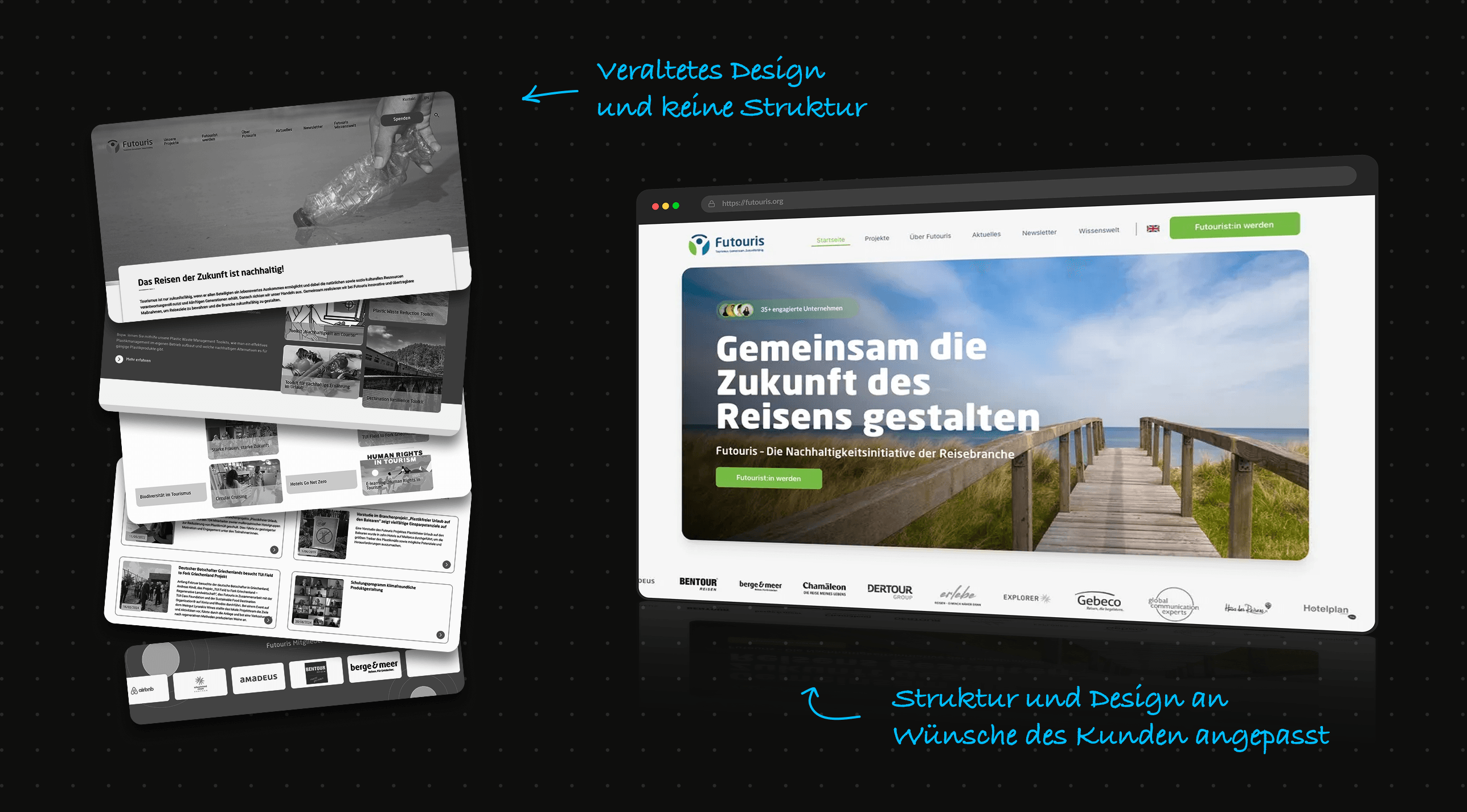
At the time Futouris got in touch, it was in a difficult situation with its previous agency. There had been significant delivery problems, and numerous tasks were still outstanding. The existing website was based on WordPress and gave staff no way to update content independently, quickly and easily, or to create new pages. Every change required the involvement of an agency.
It is worth emphasizing that the problem did not lie with WordPress as a system, but with the specific implementation. The architecture of the existing solution was not designed to meet the editorial needs of an organization with extensive content.
A joint review of the status quo found that the presentation and organization of the toolkits in particular were highly complex. The nested information architecture posed a central challenge, both technically and editorially. The goal was to create a fast, high-performance website that would effectively communicate Futouris’s extensive knowledge to the outside world.
APPROACH
The chosen approach was based on the principle of a headless CMS. Decoupling technology, design and content made it possible to clearly separate responsibilities. This allowed Futouris to focus entirely on maintaining its content, while technical and design improvements could be made independently.
This architectural approach directly addressed the core problem with the previous solution: dependence on an external agency for every content change.
TECHNICAL IMPLEMENTATION
Frontend framework: Nuxt.js. The decision to use Nuxt.js was based on several factors. The framework offers a range of built-in technologies that enable efficient development. Its developer experience also proved ideal for this project: new components could be created quickly, and problems could be identified and resolved promptly. Drawing on previous experience with the framework, the website was built in a very short time.
Content management: Storyblok. Storyblok was used as the CMS. Storyblok offers a free version for smaller projects and is straightforward to set up. The platform provides intuitive forms for managing content and a live preview feature that shows changes on the website immediately, before they are published.
Hosting: Vercel. Vercel was chosen because it is quick and easy to connect. The platform makes it possible to create multiple versions and, if needed, roll back changes—a key advantage for operational reliability.
Analytics: Umami. Umami was implemented to analyze website visitors. It is a GDPR-compliant analytics tool hosted within the EU that does not collect personal data. Umami still provides detailed statistics and can be integrated without complex cookie banners. This was particularly important for a nonprofit organization like Futouris, where data protection is a particularly high priority.
RESULT
At the end of the project, Futouris had a fast, high-performance website that consistently reflects the organization’s corporate identity. The toolkits can now be updated dynamically and edited directly in Storyblok, without any technical changes to the website.
Futouris can also, for the first time, track and analyze page views and user behavior in a privacy-compliant way—a capability it did not have before.
Staff can independently update content, create new pages and review changes in real time. This has eliminated the organization’s dependence on an external agency for content updates.
CONCLUSION
The futouris project demonstrates that technology decisions must always be made in the context of an organization’s needs. Choosing a headless CMS approach, separating technology from content and using privacy-compliant analytics tools were not isolated technical decisions, but direct responses to the specific needs of a nonprofit organization with an extensive body of publicly accessible knowledge.
The central lesson of this project is the importance of editorial autonomy: an organization whose core expertise lies in sharing knowledge must be able to publish its content independently and efficiently. The technical infrastructure must serve this goal—not the other way around.